

Summary of Site Visits to Some of Italy's Marine Protected Areas: Cape Rizzuto
Capo Rizzuto
Calabria is the toe of Italy's boot, and along the southern coast of Calabria lies a remarkable marine protected area called Capo Rizzuto. Given the size of Capo Rizzuto (55 square miles) its relatively long coastline (26 miles), three satellite offices and visitor center/aquarium, and well developed management programs, it is the marine protected area that has many of the same elements as a United States national marine sanctuary.
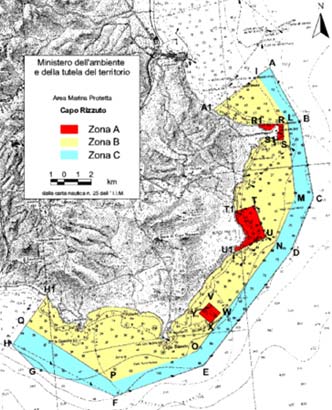 |
| Map of Capo Rizzuto marine protected area, in Calabria Italy. |
After original designation of Capo Rizzuto, the public helped to revise the management plan and boundaries for Zone A and B. The revised plan had more support from local fishermen and businesses, that have in turn expanded the opportunities for the marine protected area to meet its resource protection objectives. Today, 4% of the marine protected area is in Zone A, prohibiting most access and all forms of fishing. And, another 65% is in Zone B, which for Capo Rizzuto, restricts some access, for instance requiring diving to be guided, and only allows fishing by local-born commercial fishermen who get a permit from the marine protected area; sport fishing is allowed only with a fishing pole.
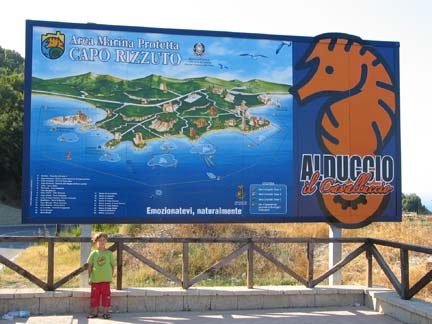 |
| One of six, large, unique and compelling roadside signs used by Capo Rizzuto marine protected area to identify locations of interest and entry to the marine protected area. |
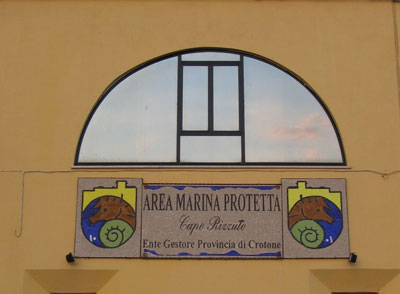 |
| Large wall sign for Capo Rizzuto marine protected area, and evening drifting clouds, at public outreach site. |
Capo Rizzuto has a well developed outreach program that includes effective, large roadside signs to ensure visitors understand what activities are allowed in the various zones. It uses simple map handouts to also educate the public. It has developed several offices that function as outreach centers, the most popular of them open 7 days a week. Like other marine protected areas in Italy, Capo Rizzuto has excellent, colorful publications that are filled with professional photographs of the incredible, diverse marine life in the marine protected area. An impressive publication is the site's well done magazine publication, Calypso, where many of these photos are shown.
The marine protected area runs an aquarium, the only one in Calabria, that serves as a regional education center about oceans and the marine protected area. They science staff of the protected area also use the aquarium facilities to rehabilitate sea turtles (Caretta caretta), with about a dozen treated for injuries and released each year.
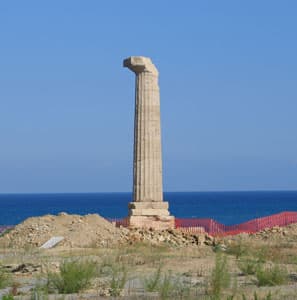 |
| Ancient Greek column, in former city of Collone, rests on edge of bluff above Zone A of Capo Rizzuto. |
The site employs some sophisticated management tools. For instance, it has detailed habitat maps that were used in the new zoning process and the data are used in GIS tools for decision making. The site has also implemented a state of the art remote camera system allowing it the ability to monitor, 24/7/365, human uses in the restricted zones. Violators observed on camera are met by coast guard and port police often while still in the protected zones.
Capo Rizzuto marine protected area also has extensive archaeological resources both within its waters and on the coastal bluffs above the protected areas. The ancient school of Pythagorus near Collone rests on a bluff above one of the marine protected area's Zone As. At that site, an ancient Greek column marking the end of the road, literally, is only several meters away from an eroding bluff. Yet discovered in the waters below is the ancient port of Collone, used by the Greeks and Romans over 2,000 years ago.
Management responsibility for the marine protected area is with the province of Crotone.
For more information about Capo Rizzuto marine protected area, go to: http://www.riservamarinacaporizzuto.it/index2.htm
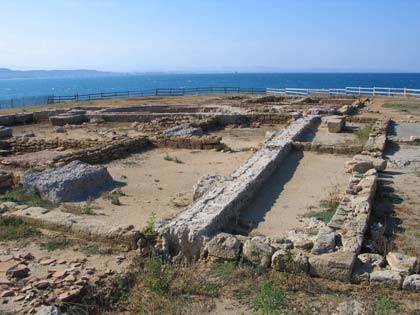 |
| Ancient school of famous Greek mathematician, Pythagorus, on bluff above Capo Rizzuto marine protected area. |