

Research Technical Report
A JPEG version of this poster is available here: dsmposter2003.jpg (432KB) |
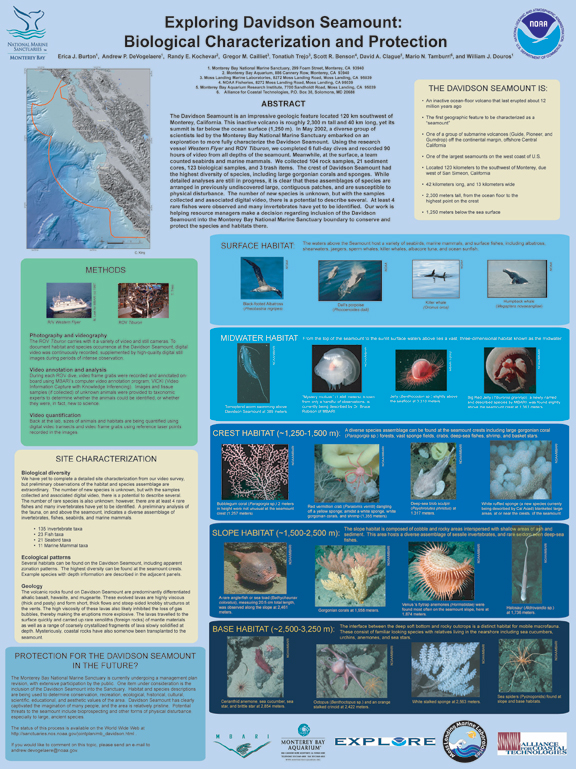
Exploring Davidson Seamount: Biological Characterization And Protection
Burton, E.J., A.P. DeVogelaere, R.E. Kochevar, G.M. Cailliet, T. Trejo, S.R. Benson, D.A. Clague, M.N. Tamburri, and W.J. Douros (2003)
Poster presented at:
- 10th Deep-Sea Biology Symposium, Aug 2003, Coos Bay, OR
- 84th Western Society of Naturalists Annual Meeting Nov 2003, Long Beach, CA
ABSTRACT
The Davidson Seamount is an impressive geologic feature located 120 km southwest of Monterey, California. This inactive volcano is roughly 2,300 m tall and 40 km long, yet its summit is far below the ocean surface (1,250 m). In May 2002, a diverse group of scientists led by the Monterey Bay National Marine Sanctuary embarked on an exploration to more fully characterize the Davidson Seamount. Using the research vessel Western Flyer and ROV Tiburon, we completed 6 full-day dives and recorded 90 hours of video from all depths of the seamount. Meanwhile, at the surface, a team counted seabirds and marine mammals. We collected 104 rock samples, 21 sediment cores, 123 biological samples, and 3 trash items. The crest of Davidson Seamount had the highest diversity of species, including large gorgonian corals and sponges. While detailed analyses are still in progress, it is clear that these assemblages of species are arranged in previously undiscovered large, contiguous patches, and are susceptible to physical disturbance. The number of new species is unknown, but with the samples collected and associated digital video, there is a potential to describe several. At least 4 rare fishes were observed and many invertebrates have yet to be identified. Our work is helping resource managers make a decision regarding inclusion of the Davidson Seamount into the Monterey Bay National Marine Sanctuary boundary to conserve and protect the species and habitats there.