


Assessment of Deep Diving Whales Major Distribution Within the MBNMS
Introduction
Currently the U.S. Navy is consulting with the Director of the Office of National Marine Sanctuaries in order to deploy Surveillance Towed Array Sensor System Low Frequency Active Sonar (SURTASS LFA) within the Monterey Bay National Marine Sanctuary. The sonar system is a long-range, low frequency sonar that has both active and passive components. The purpose of the proposed action is to meet U.S. need for improved capability to detect foreign submarines at long range. The characteristics and operating features of the active component (LFA) are:
- The source is a vertical line array of up to 18 source emitters suspended below the vessel.
- LFA's transmitted beam is omnidirectional (360 degrees along a horizontal plane (nominal depth of the center of the array is 122m [400 ft]), with a narrow vertical beamwidth that can be steered above or below the horizontal axis.
- The source frequency is between 100 and 500 Hz. A variety of signal types can be used including continuous wave (CW) and frequency-modulated signals.
It is possible that this deployment of acoustics will adversely affect Sanctuary resources. Operation of the SURTASS LFA system may constitute a violation of federal regulations at 15 CFR (922.132 (5)) which prohibit taking any marine mammal, sea turtle or seabird in or above the Sanctuary, except as permitted by regulations, under the Marine Mammal Protection Act, the Endangered Species Act, and the Migratory Bird Treaty Act. NOAA Fisheries (NMFS) will determine whether to grant the Department of Defense a small take exemption under the Marine Mammal Protection Act.
The FEIS for SURTASS LFA Appendix A states: "Sanctuary regulations require that military activities be carried out in a manner that avoids to the maximum extent practicable adverse impacts on Sanctuary resources and qualities. The Navy has determined that Alternative 1 of the Draft OEIS/EIS would meet this requirement".
Sanctuary regulations at 15 CFR 922.132 (c) except some Department of Defense activities from the above prohibitions, but only military activities specifically identified in the MBNMS Final Environmental Impact Statement/ Management Plan (FEIS/MP) published in June 1992. Sanctuary regulations are very clear in stating that the prohibitions in paragraphs (a) (2) through (9) do not apply to existing military activities carried out by the Department of Defense. SURTASS LFA was not identified as a pre-existing activity in the 1992 FEIS/MP, and would therefore not be eligible for exception from these prohibitions. However, new activities may be exempted after consultation between the Director and the Department of Defense.
We understand the intent of the Navy's proposal is to keep the sound source outside the limits of the United States Territorial Sea. This should reduce potential impacts to the migrating Gray whales during the winter and spring. However, the Monterey Bay National Marine Sanctuary has concerns regarding the variety and distributions of deep diving whales throughout our boundaries, in particular, offshore areas beyond the Territorial Sea during spring, summer, and fall.
Deep Diving Whales Range Distribution Charts
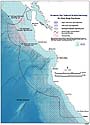
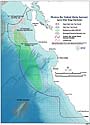
The Sanctuary has compiled charts of the range and distribution of some of the deep-diving whale species present within our region. All of these species are either threatened or endangered, and all are sought by a growing number of whale watching boats in central California. These data are summarized below.
|
|
|
|
|
|
|
|
|
|
|
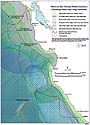 Chart
1 -- Deep Diving Whales Major Range
Distribution
Chart
1 -- Deep Diving Whales Major Range
Distribution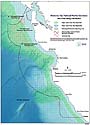
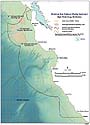
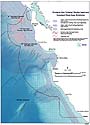
Beaked Whales
The Monterey Bay National Marine Sanctuary has three species of
beaked whales that inhabit our waters – the Baird's, Cuvier's
and Hubbs beaked whale. Little is known about these cetaceans.
They may be rare or merely elusive, but generally they live in
deep offshore waters and have escaped live studies.
Studies of dead beaked whales from the March 2000 Bahamas strandings
by Kenneth Balcomb, indicate that a resonance phenomena in the
whales cranial airspaces may be responsible for tearing apart
the delicate tissue around the ears and brain. Kenneth Balcomb
further reiterated that the resonance frequency of airspaces in
Cuvier's beaked whales to be about 290 Hz at 500 meters depth,
which is precisely the middle frequency of LFA as described in
the OEIS/EIS.
Marine
Table 1 was generated from data compiled by the National Marine Fisheries Service and reports the estimated Pacific populations as well as the estimated California populations for the following species of whales: Blue, Humpback, Fin, Minke, Gray, Northern Right, Sperm, Cuvier's Beaked, Baird's Beaked, and Mesoplodont Beaked. Migrating species are indicated seasonally on the right of the table.
From: Forney et al. 2000, U.S. Pacific Marine Mammal Stock Assessments:
2000.
NOAA Technical Memorandum NMFS/SWFSC 300
|
Species |
Estimated Pacific Population |
CV |
CA Estimated Population* |
CV* |
Winter |
Spring |
Summer |
Fall |
|
Blue Whale |
1940 |
0.15 |
not calculated |
Migrating S |
Migrating N |
Present |
Present |
|
|
Humpback Whale |
905 |
0.06 |
319 |
0.41 |
Migrating S |
Migrating N |
Present |
Present |
|
Fin Whale |
1236 |
0.2 |
49 |
1.0 |
Lower #'s |
Lower #'s |
Present |
Present |
|
Minke Whale |
631 |
0.45 |
73 |
0.62 |
Present |
Present |
Present |
Present |
|
Gray Whale |
26635 |
0.1006 |
not calculated |
Migrating S |
Migrating N |
Absent |
Absent |
|
|
Northern Right Whale |
Unknown |
not calculated |
Possible |
Unknown |
Unknown |
Unknown |
||
|
Sperm Whale |
1191 |
0.22 |
892 |
0.99 |
Present |
Peak |
Peak |
Present |
|
Cuvier's Beaked Whale |
5870 |
0.38 |
not calculated |
Possible |
Possible |
Possible |
Possible |
|
|
Baird's Beaked Whale |
379 |
0.23 |
not calculated |
Lower #'s |
Lower #'s |
Possible |
Possible |
|
|
Mesoplodont Beaked Whales |
4098 |
0.5 |
not calculated |
Possible |
Possible |
Possible |
Possible |
CV= Coefficient of Variation
Table 2 is taken from the Final EIS/EIR for the California ATOC project and estimates the marine mammal stock of the following species of whale: Blue Humpback, Fin, Minke, Gray, Sei, Northern Right, Sperm and Beaked for the offshore central California area. This table separates Winter/Spring populations from Summer/Fall populations.
From: Final EIS/EIR for the California Acoustic Thermometry of Ocean Climate Project, April 1995. Estimates of the stock of marine mammal species offshore central California
|
Species |
Winter/Spring |
CV |
Summer/Fall |
CV |
|
Blue Whale |
28 |
1.03 |
2198 |
0.36 |
|
Humpback Whale |
375 |
0.36 |
609 |
0.41 |
|
Fin Whale |
78 |
0.8 |
913 |
0.59 |
|
Minke Whale |
71 |
0.61 |
569 |
1.1 |
|
Gray Whale |
20869 |
0.34 |
not calculated |
|
|
Sei Whale |
not calculated |
61 |
1.21 |
|
|
Northern Right Whale |
16 |
1.08 |
not calculated |
|
|
Sperm Whale |
857(1286)* |
1.05 |
725(1088)* |
0.47 |
|
Beaked Whales (Cuvier's, Baird's, Mesoplodont) |
426(852)* |
0.38 |
1430(2860)* |
0.91 |
* Numbers in ( ) indicate estimates accounting for whales submerged
during entire survey evolution
CV= Coefficient of Variation
Sea
Table 3 is taken from the Final EIS/EIR for the California ATOC project and estimates the following sea turtle species: Leatherback, Green, Olive and Loggerhead. The abundance of these species is unknown.
From: Final EIS/EIR for the California Acoustic Thermometry of
Ocean Climate Project, April 1995
Estimates of the stock of sea turtle species offshore central
California
|
Species |
Abundance |
Remarks |
|
Leatherback Sea Turtle |
Unknown |
Note 13 |
|
Green Sea Turtle |
Unknown |
Note 11,12 |
|
Olive Ridley Sea Turtle |
Unknown |
Note 11 |
|
Loggerhead Sea Turtle |
Unknown |
Note 11 |
Note 11: NOAA-TM-NMFS-F/SPO-2, Dec 1992 (for eastern tropical Pacific [ETP])
Note 12: "Green turtles are the most commonly observed hard-shelled sea turtle
on the western coast of the USA." (NOAA-TM-NMFS-SWFSC-186, Sep 193)
Note 13: Predominant sea turtle in central California coastal area (Eckert, pers. Comm., 1994)
Acoustic
The University of California at Santa Cruz, Marine Mammal and Seabird Ecology Group has produced a technical report for LFA EIS entitled Marine Vertebrates and Low Frequency Sound that states:
Richardson et al. (1991) found that belugas have an auditory threshold of 40 dB. This suggests, by analogy, that belugas experience discomfort at sounds of 140-160 dB (Gordon and Moscrop 1996). If cetaceans such as baleen whales have similarly low auditory thresholds for LFS, then sound levels of 195-210 dB could result in immediate damage and permanent threshold shift (PTS).
Because all species of mysticete whale recorded to date produce loud, species-specific signals in the low-frequency band, they are particularly at risk from manmade LFS. It is unclear whether low-frequency signals produced by most mysticetes are used for communication, orientation, navigation, or detection of predators and prey. However, disruption of any of these functions could interfere with normal activities and behavior, and potentially impact the reproductive success of individuals and eventually the size of a population.
Furthermore, Whale Biologist Kenneth C. Balcomb, has stated in a letter sent to Mr. J.S. Johnson, SURTASS LFA Sonar OEIS/EIS Program Manager, dated February 23, 2001 that:
Based on two significant mass mortality events (Greece and the Bahamas) the body of evidence indicates that not only is resonance with LFA and sonar frequencies a problem for beaked whales, the sound pressure level of 180 db RL is demonstrably not safe for beaked whales and is probably not safe for other cetaceans.
NEPA
The following is a list of public hearings held by the Department of Defense regarding LFA: Norfolk, Virginia 1999, San Diego, California 1999, and Honolulu, Hawaii 1999. The National Environmental Policy Act requires agencies to provide public notice to people and agencies who may be interested or affected (40 CFR 1506.6[b]) and to those who have requested it (40 CFR 1506.09(b)(1). The residents of the communities adjacent to the Sanctuary boundaries were not adequately informed of this proposed project.
Furthermore, it is the position of the MBNMS that the latest research mentioned above presents a seriously different picture of the likely environmental consequences of the proposed action not adequately envisioned by the original EIS, such that the Navy's failure to act on it may be arbitrary or capricious. A Supplemental Environmental Impact Statement (SEIS) would assist in adequately addressing potential ill effects of SURTASS LFA to species in the marine environment offshore central California.
The Sanctuary recognizes that thus far the Department of Defense has spent in excess of $350 million dollars developing the technology for this project. We applaud their dedication to ensuring, as stated in the FOEIS/EIS, "monies expended on the SURTASS LFA sonar program do not bind the Navy to deploy the SURTASS LFA sonar as proposed".
Observers
The Department of the Navy proposes in the Final Environmental Impact statement (p.2-14) to use visual monitoring for marine mammals and sea turtles from the SURTASS LFA sonar vessel during daylight hours. Generally, cetaceans spend over 90% of their lives below the water surface. This being stated, it is easy to comprehend why ship-based observers may be unsuccessful in identifying potentially impacted animals.
Research Activities
The Monterey area is recognized nationally and internationally for the extensive myriad research activities and organizations that are active in the region. Annually $160 million is spent on marine research at twenty-six facilities within the region. This research is conducted on a year-round basis throughout Sanctuary waters, but typically more effort is expended during the summer months. Hundreds, if not thousands, of research projects are conducted in Sanctuary waters each year. Obviously, underwater sound would have undesirable ramifications on these on-going studies and projects.