

Marine Mammals
III. Cetaceans (whales, dolphins and porpoises)
The cetaceans which occur within the MBNMS are highly transitory, although some individuals may be residents within the area. The large baleen whales either migrate through the MBNMS (i.e. gray whales) or move into the area to feed during the summer and fall (e.g. blue and humpback whales). Movements of smaller cetaceans probably are associated with changes in prey abundance and oceanographic conditions. In addition to specific references cited in this section, a number of publications provide good reviews of cetacean natural history (e.g. Evans 1987, Gaskin 1982, Jefferson et al. 1993, Leatherwood and Reeves 1983, Ridgway and Harrison 1989-).
A. Mysticetes (Baleen Whales)
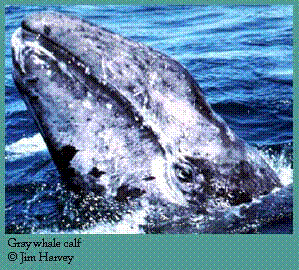 1. Gray Whale
Though virtually all populations of large whales are greatly reduced, the gray whale population is an exception: the population in 1988 was an estimated 21,100-23,000 individuals (U.S. Marine Mammal Commission 1995), probably close to historical values. Because almost the entire population of gray whales passes by Monterey within 3 km of the coast (Reilly et al. 1980), population estimates have been based on counts made periodically since 1967 (Buckland et al. 1993). Between 1967 and 1988, the average annual rate of population increase was 3.3%. Gray whales migrate annually from summer primary feeding areas off Alaska (Nerini 1984, Oliver and Slattery 1985) and secondary areas from Canada to California (Guerrero 1989, Hawkinson 1992, Oliver et al. 1984, Sumich 1984) to winter breeding and calving areas off Baja California, Mexico (Jones et al. 1984). Rarely are gray whales seen feeding in central California (Sund 1975, A. Baldridge pers. comm.). Most feeding on benthic amphipods and mysids occurs off Alaska (Kim and Oliver 1989,Oliver and Slattery 1985, Oliver et al. 1983). Gray whales, especially calves, fall prey to killer whales (Morejohn 1968, Baldridge 1972, Goley and Straley 1994).
2. Blue Whale
An estimated 2,000-2,250 blue whales occur off California (Barlow 1994, Calambokidis and Steiger 1995; Table 2). Blue whales may move along the entire California coastline during fall searching for euphausiid prey. Euphausiid swarms are often seen in great concentrations in Monterey Bay, due in part to physical mechanisms (e.g. upwelling, fronts, canyons, vertical walls) which may concentrate euphausiid prey (Harvey 1978, Schoenherr 1991). Blues have been observed feeding on dense swarms of euphausiids (dominated by either Thysanoessa spinifera or Euphausia pacifica) near Monterey (Schoenherr 1988, 1991) and the Farallones (Rice 1977, Kieckhefer 1995).
3. Humpback Whale
Humpback whales are one of the most common large baleen whales seen in the MBNMS, though California estimates are significantly lower than those for blue whales (Barlow et al. 1995; Table 2). Humpback whales were seen three times more frequently than other baleen whales on shipboard surveys conducted July 1994 to February 1995 off Point Sur (Harvey et al. 1995). Humpback whales are seen most frequently off central California during fall (Dohl et al. 1983); feeding, primarily on euphausiid prey, has been well documented around the Farallon Islands (Kieckhefer 1992). Most evidence indicates that the humpback whales feeding off California have moved north from areas used during winter off Mexico (Baker et al. 1986).
4. Minke Whale
Numerous sightings of minke whales have been documented in nearshore waters of southern Monterey Bay, Carmel Bay and south to Point Sur (Stern et al. 1990, A. Baldridge pers. comm.). As sightings are usually of single individuals, they are easily overlooked and therefore underestimated in aerial overflights (Dohl et al. 1983). Minkes are observed in the MBNMS year-round, though less commonly during winter (A. Baldridge pers. comm.).
5. Other Baleen Whales
The remaining species of baleen whales (sei, right, and fin) are seen less frequently in the MBNMS (Table 2). A very rare northern right whale was observed in May 1995 off Point Piedras Blancas (W. Perryman pers. comm.). Previous sightings in the MBNMS occurred nearly a decade earlier (individual sightings in 1986 and 1987 off Half Moon Bay; Scarff 1987).
B. Odontocetes (toothed whales)
1. Sperm Whale
The largest toothed whale, the sperm whale, is not frequently reported in the MBNMS (Barham 1982), although it is the most abundant large whale in the eastern North Pacific (Gosho et al. 1984; Table 2). Areas of deep water, where they often are associated, are infrequently surveyed (Fiscus and Niggol 1965). Dohl et al. (1983) considered sperm whales undersampled and relatively abundant. Note that Fiscus and Rice (1974) described food habits of 552 individuals taken from 1959-70, many of these in or close to MBNMS waters. Many of the sperm whales observed are greater than 30 km from shore and in the vicinity of the MBNMS (Fiscus and Niggol 1965, Carretta and Forney 1993). Recently, numerous sightings have been recorded near Pioneer Seamount during aerial surveys (J. Calambokidis pers. comm.). Sperm whales and beaked whales do at times occur relatively close to shore in the MBNMS because the of the deep water associated with the Monterey Canyon.
2. Beaked Whales
Beaked whales, like sperm whales, are closely associated with deep water, because they feed primarily on mesopelagic species of cephalopods and fishes. They are infrequently observed in California (Table 2). In 239 trips (from 1950 to 1955) to a station 11 km northeast off Point Pinos, Barham (1982) never observed beaked whales. However, Baird's beaked whales have been recorded annually during fall in MBNMS waters beyond Barham's cruise track (American Cetacean Society Monterey Bay 1980-1995). Because beaked whales are rare, usually found farther offshore, and are less approachable, these species are rarely seen or studied.
3. Pelagic Dolphins and Porpoises
 Dolphins and porpoises commonly observed in pelagic waters of the MBNMS
include: Pacific white-sided dolphin, northern right whale dolphin, Risso's
dolphin, long- and short-beaked common dolphin, killer whale and Dall's
porpoise (Table 1 and Table
2). The first three species often form mixed groups of two or more species.
Striped dolphins have not been observed at sea, but three strandings have
occurred in the MBNMS (A. Baldridge pers. comm.)
Dolphins and porpoises commonly observed in pelagic waters of the MBNMS
include: Pacific white-sided dolphin, northern right whale dolphin, Risso's
dolphin, long- and short-beaked common dolphin, killer whale and Dall's
porpoise (Table 1 and Table
2). The first three species often form mixed groups of two or more species.
Striped dolphins have not been observed at sea, but three strandings have
occurred in the MBNMS (A. Baldridge pers. comm.)
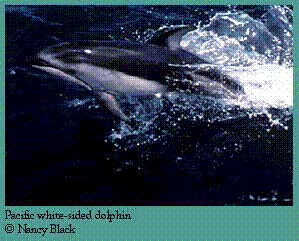
4. Pacific White-sided Dolphin
Pacific white-sided dolphins are the second most common cetacean observed off California (Table 2), with the greatest concentration off central California (Fiscus and Niggol 1965, Leatherwood and Walker 1982). This species was the most frequently seen dolphin in Monterey Bay by Barham (1982), though it has recently been replaced in abundance by common dolphins (pers. obs.). Pacific white-sided dolphins are commonly seen near the shelfbreak (primarily within 15 km west of Carmel Bay and within 25 km southwest of Santa Cruz) during fall and least abundant during spring (Black 1995).
5. Risso's Dolphin
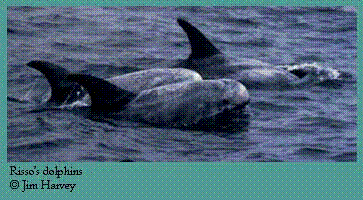 Risso's dolphins are relatively common off California (Table
2). They were considered abundant in Monterey Bay in the late 19th century,
but were seen infrequently in the bay from 1959 to 1975 (Leatherwood et
al. 1980). Fiscus and Niggol (1965) reported 10 sightings of Risso's dolphins
off central California from 1958 to 1961, six of which were within the MBNMS.
There seems to have been a significant increase in the number of Risso's
dolphins in the MBNMS since 1973 (Baldridge pers. comm.), and they can often
be observed west of Point Pinos (Harvey et al. 1995, American Cetacean Society
Monterey Bay 1980-1995).
Risso's dolphins are relatively common off California (Table
2). They were considered abundant in Monterey Bay in the late 19th century,
but were seen infrequently in the bay from 1959 to 1975 (Leatherwood et
al. 1980). Fiscus and Niggol (1965) reported 10 sightings of Risso's dolphins
off central California from 1958 to 1961, six of which were within the MBNMS.
There seems to have been a significant increase in the number of Risso's
dolphins in the MBNMS since 1973 (Baldridge pers. comm.), and they can often
be observed west of Point Pinos (Harvey et al. 1995, American Cetacean Society
Monterey Bay 1980-1995).
6. Northern Right Whale Dolphin
Northern right whale dolphins are usually observed with other species. This species is most frequently seen south of the MBNMS (Fiscus and Niggol 1965). Like the Risso's dolphin, the Northern right whale dolphin appears to have increased in MBNMS waters since 1973; the two species are frequently associated (A. Baldridge pers. comm.)
7. Common Dolphin
Two morphological forms of the common dolphin have been described as two separate species; the long-beaked (Delphinus capensis) found closer to shore and the short-beaked (Delphinus delphis) a more pelagic species (Heyning and Perrin 1991). These dolphins are the most abundant cetaceans off California (Table 2), and are most concentrated in the southern California Bight (Forney et al. 1995). The abundance of long-beaked common dolphin has have increased recently in the MBNMS (A. Baldridge pers. comm.).
8. Killer Whale
Killer whales are relatively uncommon, transient inhabitants of the MBNMS (Table 2). Killer whales off California likely move continuously along the coastline of western North America. Recently, three killer whales observed attacking gray whales in Monterey Bay, were identified as individuals previously seen in Glacier Bay, Alaska (Goley and Straley 1994). Transient killer whales often prey upon marine mammals, and gray whales and California sea lions are their primary targets in the MBNMS (Baldridge 1972, Morejohn 1968, Ternullo et al. 1993).
9. Dall's Porpoise
The Dall's porpoise is the most pelagic of the porpoises in the MBNMS, and was the most frequently seen cetacean in surveys off Point Pinos (Barham 1982). A large proportion of the Dall's porpoise sightings from 1958 to 1961 were within the MBNMS (Fiscus and Niggol 1965). This species is often seen over the Monterey Canyon (Harvey unpubl. data).
10. Coastal Dolphins and Porpoises
The more coastal species of cetaceans include the bottlenose dolphin and harbor porpoise. In the early 1980s, bottlenose dolphins were first observed in Monterey Bay (Wells et al. 1990). Some of these individuals had been previously photo-identified in southern California waters and subsequently were resighted there (ibid). At least 40 individuals have been identified using distinctive markings, and more than 45 have been sighted during one survey (Feinholz unpubl. data). This species is now considered a resident of the bay, and is confined to within one km of shore, usually travelling just outside the breakers. This is close to the area frequented by harbor porpoise, which are much more abundant (Table 2). Harbor porpoise were more abundant off northern California than in the MBNMS region (Barlow et al. 1988), though a high concentration of harbor porpoise has been recorded in summer and autumn off Sunset State Beach in northern Monterey Bay (Dorfman 1990).
| < Previous Section II. Pinnipeds (seals and sea lions)A. Eared seals |
||