

Resource Issues: Krill Harvesting
NOAA Protects All Species of Krill off the West Coast
The National Oceanic and Atmospheric Administration's (NOAA) Fisheries Service published a rule prohibiting the harvest of krill by any fishing vessel operating in the Exclusive Economic Zone (EEZ; 200 nautical miles seaward of U.S. territories) off the coasts of California, Oregon, and Washington. Krill are shrimp-like planktonic crustaceans, and a critical component of the marine ecosystem.
|
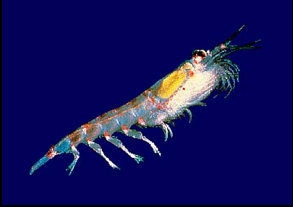
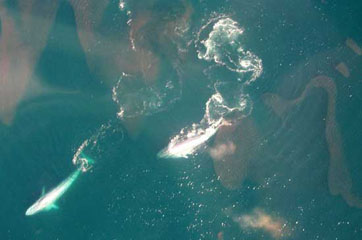
Krill are important because they convert microscopic phytoplankton into a food source for numerous other species and are a principal food source for many species of fish, seabirds, and marine mammals. Some of the species that depend on krill as prey are listed as threatened or endangered under the Endangered Species Act, and many others are important as target species for commercial and recreational fisheries on the west coast. Protecting krill will help to maintain these important ecological relationships and to ensure the long-term health and productivity of the West Coast ecosystem.
"This is a great success for protecting the entire California Current ecosystem", said William Douros, West Coast Regional Director for NOAA's Office of National Marine Sanctuaries. "This decision reflects strong teamwork within NOAA and a commitment to addressing the issues raised by the Pacific Fishery Management Council and Sanctuary Advisory Councils."
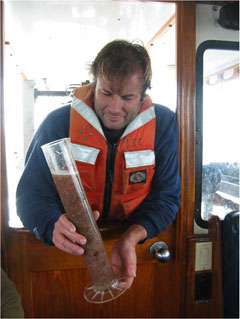 |
| Dr. Baldo Marinovic of UC Santa Cruz holds a graduated cylinder packed full of krill, an important prey item of whales and seabirds. (Photo: Rondi Robison) |
The issue of krill harvesting was raised during the public scoping process of the Monterey Bay National Marine Sanctuary (MBNMS) Management Plan Review. Several concerns about a krill fishery included:
- Wildlife viewing is a critical component of the local tourism industry. The krill fishery would coincide with peak whale abundance, competing with the whales for forage and with seabird species seasonally reliant on the resource.
- Bycatch. A very fine mesh net is used to harvest krill, and would indiscriminately catch larger predators.
- A krill fishery could adversely impact commercial and recreational fisheries of all kinds, as all target species are directly or indirectly dependent on the resource.
- Many rebuilding groundfish stocks are reliant on krill as a food source.
With NOAA's new regulation prohibiting krill fishing on the West Coast, the MBNMS is no longer concerned with these issues related to the harvest of krill.
Related Links
For more information on the the krill fishery prohibition, see the following site:
Final Rule: Federal Register, July 13, 2009 (Volume 74, Number 132)