


Geology
I. Overview
Moss Landing Marine Laboratories
P.O. Box 450, Moss Landing, CA 95039
The MBNMS spans nearly 10,000 km² in the central California region,
and extends offshore an average distance of approximately 50 km (a maximum
distance of nearly 100 km in the Monterey Bay area and a minimum distance
of 15 km off Partington Point) between the Farallon Islands in the north
and Morro Bay in the south (Figure 1).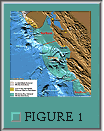 It contains
one of the world's most geologically diverse and complex seafloors and continental
margins. The MBNMS is located on a plate boundary which separates the North
American Plate from the Pacific Plate, and is marked by the San Andreas
fault system. This is an active tectonic region with common occurrences
of earthquakes, submarine landslides, turbidity currents, flood discharges
and coastal erosion. It is also a region of extensive natural and economic
resources.
It contains
one of the world's most geologically diverse and complex seafloors and continental
margins. The MBNMS is located on a plate boundary which separates the North
American Plate from the Pacific Plate, and is marked by the San Andreas
fault system. This is an active tectonic region with common occurrences
of earthquakes, submarine landslides, turbidity currents, flood discharges
and coastal erosion. It is also a region of extensive natural and economic
resources.
Coastal topography varies greatly, encompassing steep bluffs with flat-topped terraces and pocket beaches to the north; large sandy beaches bordered by cliff and large dune fields mid-sanctuary; and predominately steep, rocky cliffs to the south. Low- to high-relief mountain ranges and broad, flat-floored valleys are prevalent farther inland.
The Santa Cruz and Gabilan mountain ranges dominate the topography in the northern and central half of the region. Two major rivers (San Lorenzo and Pajaro Rivers) and a major creek (Scott Creek) enter Monterey Bay from these highlands through well defined valleys (Figure 1). Elkhorn Slough, an old river estuary that today is occupied only by tidal salt marshes, extends inland from Moss Landing for more than 10 km. The broad, extensive Salinas Valley and the northern Santa Lucia Range are the dominant topographic features in the southern half of the region; the Salinas River is the major drainage system (Figure 1). South of Monterey, the west flank of the Santa Lucia Range drops abruptly into the ocean. Here, the valleys of the Carmel and Little Sur Rivers are dominant topographic features. From Point Sur to Morro Bay many streams and creeks drain the southern Santa Lucias and cut the steep western face of the mountain range.
| < Previous Geology TOC |
||