


Kelp Forest and Rocky Subtital Habitats
I. Kelp Forest Distribution and Ecology
Moss Landing Marine Laboratories
P.O. Box 450, Moss Landing, CA 95039
A. Dominant species
The rocky nearshore environment of the Monterey Bay National Marine Sanctuary (MBNMS), like the rest of central California, is characterized by dense forests of kelp growing at depths from 2 m to more than 30 m (Foster and Schiel 1985). The giant kelp Macrocystis pyrifera and the bull kelp Nereocystis luetkeana are the dominant canopy-forming kelps in this region, and make up the major forests within the MBNMS. Giant kelp forms dense beds in the sanctuary from Cambria to Año Nuevo except in the area between Monterey and Santa Cruz where the sandy substrate is unsuitable for kelp attachment (NOAA 1992). The rocky coastline south of Monterey Bay is characterized by hard granite substrates with only a few sandy beaches which are limited to small coves (McLean 1962). North of Santa Cruz, the bull kelp, which occurs from Point Conception to Unimak Island in the eastern Aleutians (Abbott and Hollenberg 1976, Miller and Estes 1989), becomes the dominant canopy-forming kelp (Foster 1982, Foster and Schiel 1985).
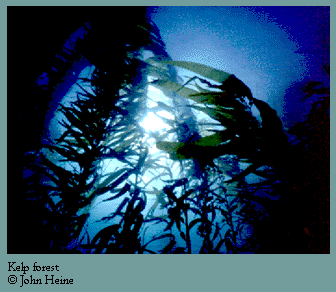 Along the central California coast where the distributions of these two species overlap, giant kelp outcompetes bull kelp for light. Giant kelp dominates areas of relatively low water motion, and is dominant in years with relatively calm sea conditions. Bull kelp is more tolerant of high water motion and dominates more exposed areas (McLean 1962, Foster 1982, Harrold et al. 1988). The shallow areas inshore of these kelp forests are often characterized by canopies of the feather boa kelp Egregia menziesii, the intertidal giant kelp Macrocystis integrifolia, and the Fucalean alga Cystoseira osmundacea (Foster and Schiel 1985).
Foster (1982) observed that at Greyhound Rock, 24 km North of Santa Cruz, kelp canopies become sparse due to the combined effects of unsuitable substrate and increased water motion. This may help explain the lack of continuous kelp forests extending from Año Nuevo to the northern end of the MBNMS at Rocky Point.
B. Seasonal patterns and kelp life histories
The seasonal patterns in the kelp forests of central California are very different from those observed in southern California. In central California, giant kelp and bull kelp exhibit their greatest recruitment in the spring and maximum canopies in early fall (Foster 1982) while kelp canopies in southern California reach their maximum in the winter. Recruitment of giant kelp sporophytes in southern California is greatest during periods of low temperatures and high nutrients, called "recruitment windows" (Deysher and Dean 1986). These conditions are nearly continuous in central California but are particularly evident during spring upwelling (McLean 1962; Breaker and Broenkow 1994) when light is also high because of canopy thinning by winter storms. These new kelp sporophytes grow from the substrate to the surface where they are supported by gas-filled bladders called pneumatocysts, and may form very dense surface canopies.
Although individual giant kelp plants can live up to seven years (Rosenthal et al. 1974), plants in central California may be shorter lived because they are removed during periods of high water motion associated with winter storms (McLean 1962; Foster 1982; Reed and Foster 1984; Harrold et al. 1988). During these periods, giant kelp survivorship is positively correlated with the hardness of the substrate to which the plants are attached (Foster and Schiel 1985). Another major source of kelp mortality along central California has been grazing by sea urchins (Strongylocentrotus spp.) (Pearse and Hines 1979, Watanabe and Harrold 1991). The effect of urchins however, has decreased due to predation by the sea otter Enhydra lutris (McLean 1962, Kenner 1992, Watanabe and Harrold 1991).
Although much is known about growth and survivorship of adult kelp sporophytes, relatively little is known about the ecology of their microscopic stages. These stages are probably highly vulnerable to grazing (Leonard 1994) and sedimentation (Devinny and Volse 1978, Deysher and Dean 1986) such as that from sewage discharges, which may thus be important in determining the distribution of kelp forests within the sanctuary (see also Meistrell and Montagne 1992). Studies on microscopic stages of giant kelp suggest they are also sensitive to the toxins associated with municipal and industrial waste discharges. For example, growth and fertility are reduced when gametophytes are exposed to elevated copper concentrations in discharge effluent (Anderson et al. 1990; see also Foster et al. 1983 for a review).
| < Previous Kelp Forest & Rocky Subtidal Habitats TOC |
||