


Shallow Soft Bottom Habitats
III. Disruptions of Zonation Pattern
A. Canyon head
The Monterey Submarine Canyon is physically and biologically similar to the head of La Jolla Canyon in San Diego (Okey 1993, Oliver et al. 1977,Shepard 1948, Shepard and Gill 1966, Vetter 1995). The canyon head is at the head of Monterey Bay, at Moss Landing. Beach sand is often transported to the canyon head from both the north and south Bay (Arnal et al. 1973).
 The sloping walls of the canyon head exhibit highly seasonal physical and
biological patterns. The walls shoal during seasons of low wave disturbance,
from early summer until fall. Drifting plants settle into the stagnant water
along the canyon axis, decompose, and decrease oxygen levels in the overlying
waters. The first fall storms trigger mass wasting of sediments and plant
debris down the canyon (also see Geology section). Although the greatest volume of sediment flushes
with these first storms, sediment movement remains high during the winter
and early spring when wave disturbance is also high. There are dramatic
seasonal changes in the type and number of animals living in the highly
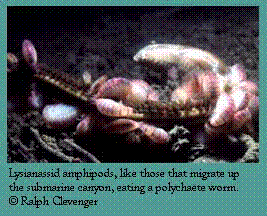
dynamic canyon areas, including large numbers of scavenging lysianassid
amphipods nestling in plant debris, followed by the recruitment of extremely
dense populations of Capitella worms, the most well known benthic weeds
(Hannan 1981). More stable canyon walls, in contrast, harbor long-lived
clams and worms burrowed into hard mud outcrops.
The sloping walls of the canyon head exhibit highly seasonal physical and
biological patterns. The walls shoal during seasons of low wave disturbance,
from early summer until fall. Drifting plants settle into the stagnant water
along the canyon axis, decompose, and decrease oxygen levels in the overlying
waters. The first fall storms trigger mass wasting of sediments and plant
debris down the canyon (also see Geology section). Although the greatest volume of sediment flushes
with these first storms, sediment movement remains high during the winter
and early spring when wave disturbance is also high. There are dramatic
seasonal changes in the type and number of animals living in the highly
dynamic canyon areas, including large numbers of scavenging lysianassid
amphipods nestling in plant debris, followed by the recruitment of extremely
dense populations of Capitella worms, the most well known benthic weeds
(Hannan 1981). More stable canyon walls, in contrast, harbor long-lived
clams and worms burrowed into hard mud outcrops.
The most impressive canyon residents are prickly sharks (Echinorhinus cookei). Divers have observed more than a dozen sharks just seaward of the Moss Landing pier; the largest can be more than 4 meters in length. Prickly sharks, seven gill sharks (Notorynchus maculutus), and lysianassid amphipods are among several deep water species that migrate up the canyon into the shallow head (Okey 1993, Varoujean 1972).
B. Wave-protected parts of Monterey Bay
The south and north ends of Monterey Bay are more protected from wave action than the broad central region. Although beach sediments are generally transported to the canyon head (Arnal et al. 1973), they are also transported into sedimentary sinks at the ends of the Bay. This results in mixed deposits of sands, muds, and light shell debris; even beds of eel grass are present. In addition to fine sediment, these calm waters accumulate dense deposits of drifting plants, both on the beach and in the subtidal habitats (Weaver 1977). The finer, mixed deposits are displaced by relatively continuous rocky habitats flanked by coarse sands that extend along much of the open coast.
C. Rock-sand ecotone
A unique benthic community exists along the interface between sand bottoms and rocky habitats (Kim 1989). The large tube-dwelling worm, Diopatra ornata, is the most conspicuous species here. These tubes can extend over a meter into the bottom. Diopatra capture and consume drifting algae which is caught in the ecotone. In deeper water, the Diopatra bed can harbor large numbers of nestling infauna, particularly small crabs and other crustaceans (Kim 1989). Diopatra communities are common along most of the open coast in the rock/sand ecotone from water depths of 10-30 meters, even around artificial reefs (Kim 1989, Davis et al. 1982). These tube mats stabilize sediments next to rocks and reduce the scouring impacts of sand on rocky habitats and communities. In addition to the usual plant and animal life which is attached to rocks, local shale reefs harbor a remarkable number of clams and worms that bore into sedimentary rocks (Burnett 1972).
Rocky habitat in the sand/rock ecotone is frequently scoured by coarse sand suspended by winter waves. The most severely scoured rocks are often colonized by barnacles that rarely survive the next winter of sand scour (Burdett 1992). Cup corals, anemones, and low growing sponges and bryozoans probably characterize less intensely scoured rocks next to sand. Burial, sand scour, and deposition of fine sediments on rocky habitats is most frequent in the sand/rock ecotone. Coastal landslides also bury nearshore habitats, are a source of blasting sand, and produce distinct plumes of suspended fine sediment that can impact biological communities in adjacent rocky habitats (Kiest 1993). Marine algae also show distinct patterns from sediment burial, sand scour, and deposition of finer suspended sediment (Bretz 1995).
| < Previous Section II. Community Zonation |
||