

Socioeconomic Uses
V. Commercial Shipping
A. Profile and revenues
 A variety of commercial vessels operate in the MBNMS, with some restrictions
on operations set by the Coast Guard and the National Oceanographic and
Atmospheric Administration (NOAA). The MBNMS lies within the Southern Approach
Lane of the San Francisco Bay Vessel Traffic Separation Scheme, a vessel
routing system directing vessel traffic into north, south, and west routing
patterns upon approach to the San Francisco Bay (Figure
9). San Francisco Bay is one of the nation's busiest ports (Townsend
and Glazer 1992).
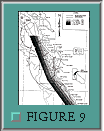
A variety of commercial vessels operate in the MBNMS, with some restrictions
on operations set by the Coast Guard and the National Oceanographic and
Atmospheric Administration (NOAA). The MBNMS lies within the Southern Approach
Lane of the San Francisco Bay Vessel Traffic Separation Scheme, a vessel
routing system directing vessel traffic into north, south, and west routing
patterns upon approach to the San Francisco Bay (Figure
9). San Francisco Bay is one of the nation's busiest ports (Townsend
and Glazer 1992).
Commercial vessels in the MBNMS consist primarily of cargo-carrying container ships, oil tankers, gas and chemical tankers, and vehicle carriers. While there are no estimates of the frequency of commercial vessel occurrence specifically in the MBNMS, it is estimated that over 2000 commercial vessels use the Southern Approach Lane each year. Most of these ships pass through MBNMS (Townsend and Glazer 1992). There are no harbors within the MBNMS capable of berthing the largest classes of ships, though smaller vessels enter Monterey Bay and oil tankers occur within 5-25 miles from shore (Figure 9; NOAA 1992, Townsend and Glazer 1992). Since commercial vessels in California operate mainly between Santa Barbara, San Diego and San Francisco ports, MBNMS ports obtain little revenue from shipping operations (California Resources Agency 1995).
B. Vessel traffic patterns
The volume and nature of commercial vessel traffic through the central coast and elsewhere along the California coast has not been systematically tracked. No federal or state agency is responsible for monitoring contents or position of cargo and tanker ships, and traffic patterns vary according to a number of factors including weather, economics, and company discretion. No restrictions on vessel traffic routes exist outside San Francisco Bay (Townsend and Glazer 1992).
Available data on vessel volume and movement is limited to studies conducted by a variety of public and private entities employing a variety of criteria. Private shipping companies, the San Francisco Marine Exchange, and the U. S. Army Corps of Engineers have kept records of the number and types of commercial vessels entering and leaving San Francisco Bay area ports (Townsend and Glazer 1992). Information dating before 1987 is available, for a fee, through the San Francisco Marine Exchange (S. Gibbs pers. comm.). Vessel traffic specifically within MBNMS was recently investigated in a congressionally-mandated study now in draft form awaiting agency approval (USCG/NOAA 1995).
The San Francisco Marine Exchange reports that the overall volume of commercial vessel traffic arriving in San Francisco Bay ports has remained steady since 1987 with oil tankers comprising between one-quarter and one-third of vessels counted. In 1992, 3646 vessels entered the Bay, and 1090 of these were oil tankers. Last and next port of call data, which track individual ships' stops, indicate that up to 58% of arriving vessels used the Southern Approach Lane (Townsend and Glazer 1992). The U.S. Coast Guard and NOAA recently reported that 79 oil tankers were observed in or within several miles of MBNMS in the six month period between January and July 1994 (US Coast Guard/NOAA 1995).
C. Commercial vessel impacts
1. Oil spills
Oil spills from offshore tankers have damaged MBNMS resources in the past, and continue to pose a threat. Large and small oil spills have occurred in the vicinity of the MBNMS in the past 25 years. While spills affect entire natural communities, spill damage is often measured in bird mortality, which is more easily quantified. In 1971, two tankers collided under the Golden Gate Bridge in San Francisco Bay, spilling 20,000 gallons of oil. The oil moved as far south as San Gregorio Beach in the MBNMS and killed about 4,000 seabirds. In 1984 the oil tanker Puerto Rican spilled between 25,000 to 35,000 barrels of oil (1 barrel = 42-45 gallons oil). The slick reached Pigeon Point in the MBNMS and killed about 2,900 seabirds. In 1986, the Apex Houston leaked 616 barrels of oil across several hundred miles, from Marin to San Luis Obispo counties. The spill reached the entire length of the MBNMS. About 10,577 birds were known to have died in the spill.
In addition to the threat of large spills, small oil spills are an ongoing problem. The California Oil Spill Prevention and Response Agency reports that in 1993 alone, 39 lesser spills, mostly less than 1 barrel, occurred between Bodega Bay and Cambria, mostly from fishing vessels and recreational boats.
Available risk assessments indicate that under continued tanker traffic patterns another large oil spill in MBNMS in the next 20 years is not unlikely. The federal Minerals Management Service prepared oil spill risk assessments for the west coast in 1980 and 1988. According to these studies, for ships bound from Alaska to L.A. there is a 53% probability of a spill of 1000 barrels or more, and a 26% probability of a spill 10,000 barrels or more. According to this risk assessment, by the year 2016 a spill of 1000 barrels or more is more likely to occur than not, and such a spill may occur in the MBNMS (Townsend and Glazer 1992).
 NOAA's recent assessment
of vessel traffic in the MBNMS substantiates concerns about oil spills. NOAA
determined that within the MBNMS, the tugs and barges entrusted with assisting
tankers in narrow straits are not subject to safety inspections. Existing
oil spill response personnel and equipment are insufficient. The craggy,
rocky topography of the central coast would make cleanup from a catastrophic
oil spill very difficult; even with the best possible response, up to 60%
of the oil would remain in the environment. MBNMS resources such as sea
otters, seabirds, and tidepool organisms are particularly sensitive to spilled
oil in catastrophic and chronic levels, especially at Pillar Point, Santa
Cruz, Elkhorn Slough, Monterey Bay, Carmel Bay, and Point Piedras Blancas
(Figure 4; US Coast Guard/National Oceanographic
and Atmospheric Administration 1995).
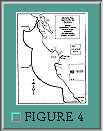
NOAA's recent assessment
of vessel traffic in the MBNMS substantiates concerns about oil spills. NOAA
determined that within the MBNMS, the tugs and barges entrusted with assisting
tankers in narrow straits are not subject to safety inspections. Existing
oil spill response personnel and equipment are insufficient. The craggy,
rocky topography of the central coast would make cleanup from a catastrophic
oil spill very difficult; even with the best possible response, up to 60%
of the oil would remain in the environment. MBNMS resources such as sea
otters, seabirds, and tidepool organisms are particularly sensitive to spilled
oil in catastrophic and chronic levels, especially at Pillar Point, Santa
Cruz, Elkhorn Slough, Monterey Bay, Carmel Bay, and Point Piedras Blancas
(Figure 4; US Coast Guard/National Oceanographic
and Atmospheric Administration 1995).
NOAA and the Coast Guard may recommend, in part, that limits be prescribed.
| < Previous Section IV. Mariculture and Kelp Harvesting |
||