


Socioeconomic Uses
VII. Agriculture
A. Description
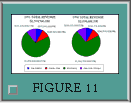 Agriculture is the largest, most valuable industry in Monterey County and
one of the most valuable industries in Santa Cruz, San Mateo, and San Luis
Obispo counties (Figure 11). Large scale agriculture
began in Monterey and Santa Cruz counties before the turn of the century,
and now is an important supplier of vegetables to California and the rest
of the country. Monterey county alone produces approximately 90% of the
country's artichokes, 80% of its lettuce, and 60% of its broccoli (NOAA
1992; Monterey Country Agricultural Commissioner 1994).
Agriculture is the largest, most valuable industry in Monterey County and
one of the most valuable industries in Santa Cruz, San Mateo, and San Luis
Obispo counties (Figure 11). Large scale agriculture
began in Monterey and Santa Cruz counties before the turn of the century,
and now is an important supplier of vegetables to California and the rest
of the country. Monterey county alone produces approximately 90% of the
country's artichokes, 80% of its lettuce, and 60% of its broccoli (NOAA
1992; Monterey Country Agricultural Commissioner 1994).
Top revenue crops for each county vary annually depending on market demand and growing conditions, but the top ten crops generally remain consistent. Ornamental nursery plants are by far the most lucrative crops in San Mateo County (San Mateo County Agricultural Commissioner 1994; strawberries, lettuce and roses in Santa Cruz Country (Santa Cruz Country Agricultural Commissioner 1994); lettuce, artichokes and broccoli in Monterey County (Monterey Country Agricultural Commissioner 1994); and grapes, lettuce, broccoli, and livestock in San Luis Obispo county (San Luis Obispo Country Agricultural Commissioner 1994). The value of the agriculture industry to the counties has increased in the last ten years; it has nearly doubled in Monterey County (Monterey County Agricultural Commissioners 1994).
B. Potential Impacts
Agricultural operations have heavily impacted terrestrial and estuarine environments in MBNMS counties, including profound modification of the landscape and hydrological regimes, aggravation of saltwater intrusion into freshwater aquifers, precipitous reductions in coastal and terrestrial biodiversity, sedimentation into coastal streams and estuaries, and introduction of toxic pollutants (ABA Consultants 1989, NOAA 1994, Watershed Ecology Outreach Program 1995, and see River Mouths, Estuarine and Coastal Wetlands section).
 While these impacts have been documented for coastal streams, lagoons and
estuaries throughout the watershed (NOAA 1994), they are most pronounced
in intensively cultivated areas such as the Salinas and Pajaro River Valleys
in Monterey and Santa Cruz Counties (ABA Consultants 1989, NOAA 1994, Watershed
Ecology Outreach Program 1995), and the Morro Bay area in San Luis Obispo
county (NOAA 1994). Land use conversion to agriculture has severely altered
or destroyed more than 90% of the wetlands and riparian forests of the Salinas
and Pajaro Valleys (Watershed Ecology Outreach Program 1995). Soil erosion
originating from strawberry fields in Elkhorn Slough has increased suspended
sediment load in many parts of the Slough, resulting in deposition in freshwater
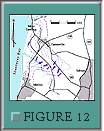
ponds and in pickleweed marshes (ABA Consultants 1989). Overpumping of groundwater
resulting in depletion of aquifers and saltwater intrusion began in the
Monterey Bay region in the 1940's and is accelerating (Figure 12; Greene
1971, Watershed Ecology Outreach Program 1995; and see Geology section).
While these impacts have been documented for coastal streams, lagoons and
estuaries throughout the watershed (NOAA 1994), they are most pronounced
in intensively cultivated areas such as the Salinas and Pajaro River Valleys
in Monterey and Santa Cruz Counties (ABA Consultants 1989, NOAA 1994, Watershed
Ecology Outreach Program 1995), and the Morro Bay area in San Luis Obispo
county (NOAA 1994). Land use conversion to agriculture has severely altered
or destroyed more than 90% of the wetlands and riparian forests of the Salinas
and Pajaro Valleys (Watershed Ecology Outreach Program 1995). Soil erosion
originating from strawberry fields in Elkhorn Slough has increased suspended
sediment load in many parts of the Slough, resulting in deposition in freshwater
ponds and in pickleweed marshes (ABA Consultants 1989). Overpumping of groundwater
resulting in depletion of aquifers and saltwater intrusion began in the
Monterey Bay region in the 1940's and is accelerating (Figure 12; Greene
1971, Watershed Ecology Outreach Program 1995; and see Geology section).
The Elkhorn Slough watershed drains extensive agricultural areas in Monterey County. For more than two decades, these areas have been dependent on heavy pesticide use; for example, see pesticide use in Elkhorn Slough watershed for 1994 alone (Table 3). This has resulted in significant pesticide contamination of Elkhorn Slough (ABA Consultants 1989, California Coastal Commission 1995). Since the late 1970's, the State Mussel Watch Program of the California Department of Fish and Game and other programs have monitored pesticide levels in sediments, water, and animal tissues in the Slough (Stephenson et al. 1995, California Coastal Commission 1995).
Persistent chlorinated hydrocarbons including toxaphene, endosulfan, endrin, dieldrin, DDT and its isomers, dacthal, chlorpyrifos, and chlordane have been detected in sediments and tissues in the Slough at levels among the highest in the state (Stephenson et al. 1995, ABA Consultants 1989). For example, mussel tissue levels of DDT and its isomers ranged from 927 to over 51,000 parts per billion in the lower Salinas River drainage area; the State threshold for tissue contamination is 32 parts per billion (California Coastal Commission 1995). Large-scale application of all of these compounds, with the exception of endosulfan, was discontinued in the 1970's and 1980's (ABA Consultants 1989), and tissue levels appear to be decreasing in many coastal areas (Stephenson et al. 1995).
However, organochlorine residue levels in Elkhorn Slough are of particular concern, because the area supports a diverse and abundant assemblage of high-level predators such as migratory shorebirds, raptors, marine mammals, and large fishes. Chlorinated compounds accumulate and/or biomagnify in food chains, resulting in much higher levels of these compounds in the tissues of predators than in their prey items (Eisler 1986). Known effects include eggshell thinning in raptors and pelicans (Risebrough and Jarman 1985) and immune suppression and reproductive failure in pinnipeds (Cummins 1988). High levels of organic contaminants have been found in sea otters and pinnipeds in MBNMS (Bacon 1995, Kopec and Harvey 1995). Despite possible reductions in environmental presence of discontinued organochlorines, endosulfan continues to be applied to agricultural lands and thus may continue to persist at high levels (ABA Consultants 1989).
In addition, existing monitoring programs are unfortunately not measuring the many new pesticides that have been introduced in MBNMS counties in recent years (M. Stephenson pers. comm.), which clearly limits current knowledge of the potential impact of these substances on MBNMS resources. Pesticide use information for MBNMS counties exists at county agricultural offices but is not readily available or easily used (California Coastal Commission 1995, though pesticide amounts applied to the Elkhorn Slough watershed, which represents a large part of Monterey county agricultural land, has been compiled for 1994 (Table 3; M. Stephenson pers. comm.). The inaccessibility of pesticide use data remains a major management concern.
| < Previous Section VI. Harbors |
||