

Underwater Habitats within MBNMS
Encompassing 6,094 square statute miles, Monterey Bay National Marine Sanctuary (MBNMS) is one of the richest, most diverse marine environments in the world, encompassing wave-swept beaches, lush kelp forests, and one of the deepest underwater canyons in North America. These habitats abound with life, from tiny plankton to playful sea otters, to the largest animal on earth -- the blue whale. Here is a brief look at some of the more common and accessible underwater habitats you may see while visiting MBNMS.
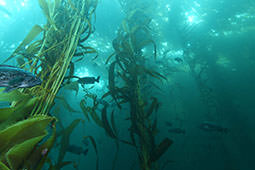
Kelp ForestsGiant and bull kelp are two species of algae that create the magnificent kelp forests that attracts divers from around the world. The familiar giant kelp (Macrocystis pyrifera) is one of nearly 20 varieties of kelp found in the sanctuary. In ideal conditions this remarkable alga can grow up to 18 inches per day, and in stark contrast to the colorful and slow-growing corals in tropical systems, the giant kelp canopies tower up to 20 meters above the ocean floor and create a three-dimensional forest. Kelp forests are among the most productive ecosystems in the sanctuary, second only to estuaries. Like terrestrial trees in a forest, kelp species provide food and shelter for many organisms, including fishes and invertebrates. Canopy-forming species of kelp alter the structure and function of a rocky reef, changing water flow dynamics, ambient light levels, and local productivity. Kelp forests also experience seasonal changes, and decline as storms and other events, like El Niño and other marine heatwaves, thin the canopy and deposit massive amounts on beaches or subsidize deep sea communities. On the rocky reef, where kelp holdfasts attach, there is an incredible diversity of invertebrates, including abalone, crabs, snails, sea urchins, and sea stars. Above the reef and among the kelp blades live a variety of fishes – and it serves as nursery habitat for young-of-the-year rockfishes. Rockfishes and senoritas swim amongst the blades, and these blades often have hungry turban snails feeding on them. The canopies attract sea birds that forage for small fishes and are considered "home" to the southern sea otter. |
|
|
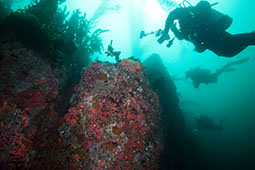
Rocky Shores and ReefsMuch of the spectacular diversity can be found nestled amongst the rock where the sanctuary meets the shore. From the intertidal zone to the sea floor, an abundance of sea stars, anemones, and algae can be found. These rocky habitats are both beautiful and fragile. The subtidal reefs host a myriad of sponges, anemones and corals, whose presence converts the dark rock to fields of vibrant color. Holes left by burrowing clams, piddocks and constant weathering become shelter for the many reef animals including agile octopi, sedentary sea cucumbers, and colorful nudibranchs. Many species of fish can be seen around rocky outcroppings. |
|
|
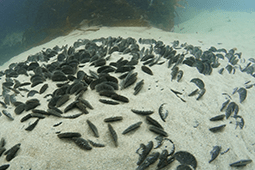
Sandy BeachesThe sandy beach and sea floor comprise the most extensive habitats in the sanctuary. At first glance the sand seems barren. After a while, if you are careful not to kick up sand, you might see tiny benthic communities of tube-building worms come alive as they sweep the passing nutrient rich waters with tentacles to capture food. Sand dabs and stingrays sail along the silty bottoms feeding or lie in wait on the sandy floor, blending in perfectly. In certain areas, a cluster of living sand dollars, half buried in the sand, will cover the bottom. As you dive deeper and the wave energy diminishes, infaunal communities appear, with tube anemones, sea pens, and brittle stars emerging out of the sand, waiting for food to slowly drift by. |
|
|
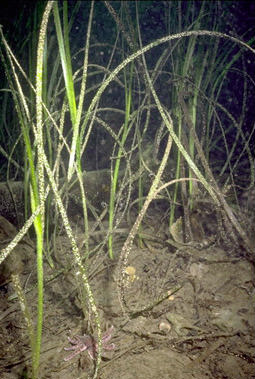
Eelgrass BedsEelgrass (Zostera marina) is a flowering plant that is able to grow underwater. Like land-bound grasses, eelgrass roots itself into the substrate and produces seeds. It thrives in protected coastal waters with sandy or muddy bottoms, and can be found in Elkhorn Slough, where populations have recently recovered. This fast-growing plant plays a crucial role in the coastal ecosystem by providing food and shelter to a variety of animals, serving as nursery habitat for juvenile fishes. Because eelgrass is a relatively stable feature in a world of swirling water and sediments, eelgrass becomes the center of a small community: shrimps and worms burrow in the root-bound sand, pipefishes hang out around the waving blades, and various fishes attached their eggs to the blades. Many juvenile fish and invertebrates find protection, food, and cover among the grass blades. Recent research demonstrates that a healthy southern sea otter population in Elkhorn Slough has contributed to the decline of some crabs, a favorite otter prey item, and this has in turn allowed sea slugs (nudibranchs) to thrive in the absence of crab predation. These sea slugs feed on algae that covers the eelgrass, which allows the eelgrass to receive more sunlight, increase local production, and thrive. |
|
|
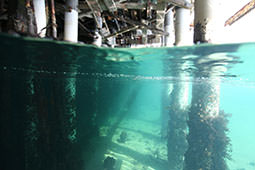
Piers and WharvesDiving near piers and wharves offers an interesting opportunity to see how animals such as anemones, sea stars, barnacles, mussels, and algae colonize man-made structures. Nudibranchs are especially common in this habitat, likely due to the diversity of prey, both in terms of sponges and hydroids. Divers are restricted from certain areas of harbors and marinas due to vessel traffic, and must be careful to avoid injuries while diving near pier pilings and other underwater structures. It is always important to obtain permission from the local harbormaster before diving near a pier or wharf. |
|
|
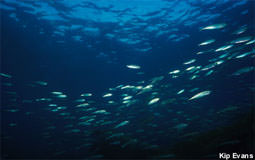
Open WatersThe vast pelagic realm contains marine life ranging in size from microscopic plankton to huge blue whales. Depending on the time of year, these spectacular open waters treat blue-water divers to sights of swirling anchovies, swarms of gelatinous salps, and maybe even glimpses of elusive whales or cruising sharks. Creatures of the open waters are superbly adapted to their fluid, edgeless world. Pelagic animals are designed to deal with problems of buoyancy and avoiding predators in a wide-open environment. If you're lucky, you may be able to see seasonal visitors such as swimming snails, pelagic jellies, or the strange looking Ocean Sunfish (Mola mola). Go back a few days later, and the variety of animals you see could be completely different. |
|
For more in-depth information on the marine organisms found in Monterey Bay National Marine Sanctuary, please visit our site characterization. |