


Restoration Plan for The M/V Med Taipei ISO Container Discharge Incident
The M/V Med Taipei Incident
Shortly before 1:00 AM on February 24, 2004, fifteen intermodal steel cargo containers fell overboard from the M/V Med Taipei as the vessel transited through the Monterey Bay National Marine Sanctuary (MBNMS) during a winter storm. A computer simulation model prepared by Fugro Inc. projected easterly drift patterns for the semi-buoyant containers, with probable deposition in the outer Monterey Bay from 9 to 30 miles (15 km - 48 km) offshore and throughout a range of water depths between 900 and 2,700 meters.
In June 2004, while conducting a deep ocean survey, scientists from the Monterey Bay Aquarium Research Institute (MBARI) discovered one of M/V Med Taipei's 40-foot long intermodal cargo containers, numbered TGHU7712262. The container (with its cargo of 1,159 steel-belted automobile tires) was resting inverted on the seafloor at a depth of 1,281 meters (4,203 feet) on Smooth Ridge, a submarine formation extending southwest from Monterey Bay, California. Fugro's drift model predicted the other 14 containers also sank within Sanctuary boundaries, yet their exact location remains unknown.
Compensatory Restoration Plan
In January 2005, NOAA's Damage Assessment Center (DAC) assessed the likely impacts of the deposition and deterioration of the 15 sunken containers over time in the MBNMS and provided an estimation of the equivalent benefits that would be needed to compensate for lost ecological services. Taking into consideration NOAA-DAC's assessment, as well as potential fines, government legal fees and costs to date, the shipping company agreed to pay MBNMS a total compensation of $3.25 million. These funds are currently supporting the implementation of a compensatory restoration plan, which has a greater certainty of success than attempting to recover the lost containers. The plan includes a suite of projects designed to restore important benthic habitats within the sanctuary and compensate for the disturbance of ecological services derived from the impact and continued presence of the cargo containers on the sanctuary's seafloor.
By implementing a diversified project portfolio, the potential for successful restoration of benthic habitats is substantially increased. The combined projects will restore ecological services in excess of the total amount of lost services calculated by the DAC assessment, thus providing an added benefit to marine conservation in the MBNMS beyond what recovery of the containers could have achieved. The compensatory restoration plan includes the following projects:
 |
Deep Benthic Assessment & Monitoring at Impact SiteThis project will monitor the characteristics and decomposition rate of container TGHU7712262, and its long-term impacts on the surrounding deep benthic habitat (flat and soft seafloor). |
|
 |
Grounded/Sunken Vessel RemovalThis project will involve removal of vessels and debris from various locations in the sanctuary to facilitate natural recovery of habitat and biota in cases where abandoned and/or derelict vessels have no known owner or other source of funding for salvage. |
|
 |
Ecosystem-Based ManagementThis project will enhance ecosystem-based management and inform coastal and marine spatial planning in MBNMS by applying best available science, integrating and coordinating with partner agencies. |
|
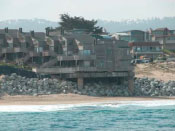 |
Maintenance and Restoration of Beach HabitatThis project addresses coastal erosion and armoring issues in MBNMS through proactive regional planning, project tracking, and comprehensive permit analysis and compliance. |
|
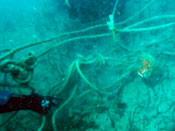 |
Subtidal Debris RemovalThis project will help to restore damaged habitat areas located at more accessible depths within the Sanctuary. |
|
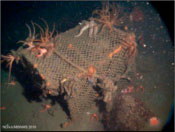 |
Lost Fishing Gear RemovalThis project will involve removal of lost fishing gear from deepwater habitats in the sanctuary, using a remotely operated vehicle (ROV). |
|
By implementing a diversified project portfolio, the potential for successful restoration of benthic habitats is substantially increased, since setbacks in any single project will not jeopardize the entire plan. In addition, the combined projects will restore ecological services in excess of the total amount of lost services calculated by the DAC assessment, thus providing an added benefit to marine conservation in the MBNMS beyond what recovery of the containers could have achieved and at a fraction of the cost.